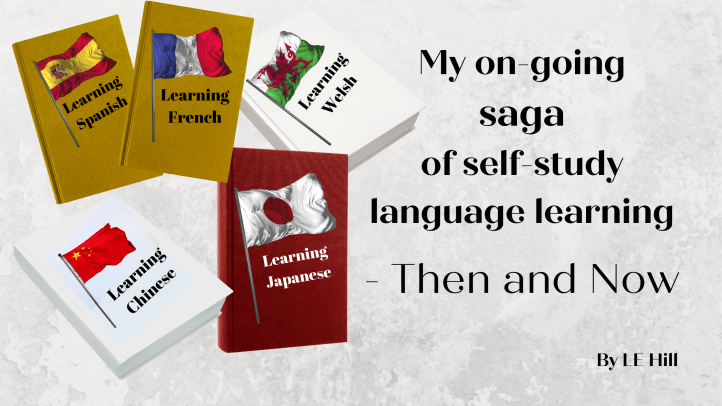
(note: let’s not talk about how many times I’ve re-written this post…)
I love hearing other languages spoken. Some sound like music, some like complete gibberish, and some oddly enough, like words I just don’t know the meanings of. And then there’s the written language, like Japanese, that is just so beautiful to me if only I could figure out how to draw the same lines.
Learning a new language on your own is easy until it’s hard, and that’s when I tend to lose interest. Methods of teaching and ways to access information have vastly changed over the years, making language learning much more accessible to everyone and every interest. And retaining the interest that made you (and me) want to learn a new language – that’s the trick to keep going when it just seems too difficult.
While I want to focus on self-study for this post, of course my introduction to learning a new language was in a classroom setting, so I’ll start there.
I took French in high school. I can’t remember if we had a textbook, I’m sure we did, but what I do remember is eating petits fours and mastering the ability to fit a semester’s worth of vocabulary and grammar rules onto an 8.5”x11” piece of paper to use as a cheat sheet. It was allowed, and so I retained little from the class. (I think I had two years of it, this was late 80’s to early 90’s.)
Mid 90’s found me in college and in a Spanish class. The professor spoke English for the first class and rarely again after that. I chose the name “Aurora” and for the entire two semesters of the class was stressed every time she said “ahora” meaning “now” because the two words sound so much alike. (I don’t like being called on in any class, but especially one in a different language…) There was a cultural element in the class that went beyond snack food, and cheat sheets were not allowed. Unfortunately, I had no one more knowledgeable than me to practice with, to make it feel less foreign if that makes sense, and once the class was over, I left it all behind. (Did we have access to tutors? Must have, but I can’t remember it ever being offered in class.)
Over 20 years later, what I remember most about language learning in both instances was vocabulary repetition for memorization and trying to understand the grammar rules of another language when I still hadn’t untangled the grammar rules of my own. I don’t know if English majors of today still have a grammar class that is mandatory, but I spent a semester diagramming sentences on a blackboard and only passed the class because the professor allowed me extra credit assignments.

After college, I dove head-first into a love of anime that has never gone away. I was shocked to learn that many of the cartoons I had watched as a kid were actually English-dubbed versions, and when I watched them in the original Japanese I fell in love with the language. I purchased Japanese dictionaries and wore out numerous pencils practicing the easier two of the three alphabets: Hiragana and Katakana. Kanji is the third, and I’ve never gotten the hang of it…which is what makes my new language adventure so interesting, but I digress…
My goal was to translate some of the Japanese manga (graphic novels) I had begun collecting, and ultimately to be able to watch an anime without the English subtitles. I was exceptionally lucky to have lived near a woman from Japan who agreed to teach me Japanese through translating manga as long as I helped her with English.
In between translating, she told me stories about growing up in Tokyo and moving to Hawaii where she met her husband, and we made oshiruku, a red bean and mochi soup that I craved for years later each winter. Eventually, we concentrated less on Japanese and more on just fun conversation over coffee – and while we would both sometimes toss in a Japanese word or phrase, those fun conversations were in English and much of my studying (using books and language cassettes) was again done on my own.
When I moved to Pennsylvania we unfortunately lost touch, but I will always be thankful to her for making learning a new language, especially one as complex as Japanese, seem less frightening than it had been when I began studying all on my own. She made it fun, and it was about my particular interests, like the manga or food.
Unlike with French and Spanish, I did retain quite a bit of what she taught me and those casual lessons led to me signing up for Japanese I and II at the local community college, through their adult learning program. This was roughly a decade after college, around 2008, and the teaching method was almost the same: a bit of culture, lots of vocabulary, grammar rules, and scripted conversations.
My collection of Japanese learning books, dictionaries, and texts was, and is, impressive. It was all that I had to work with for a long time. There were no online tutorials (that I knew of), Youtube wasn’t invented until 2005 or so and it took some time before the language learning videos began to populate the site. Self-study language learners had books, lessons on cassette, DVD, and CD-ROM, and subtitled movies on VHS or DVD if you could find them. I still have Japanese lessons on cassette, but the box is dusty from sitting on the bookshelf for so long. (Update: I dusted it off just to take a picture. I also dug up a cassette player.)
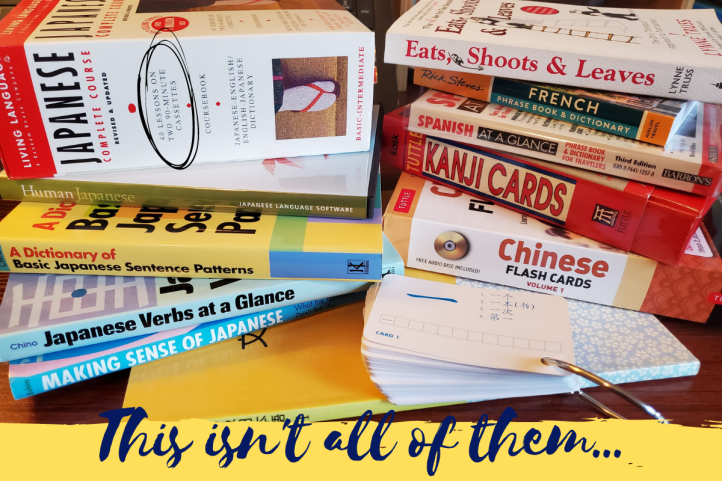
My love of Japanese has never faded, but with no one to practice with much of my vocabulary has been forgotten. I do have the habit of, when bored in a meeting, writing out the Japanese alphabet in hiragana, or as much of it as I can remember. (While everyone else uses a laptop, I’m old school and bring a notebook. Full disclosure: if I used a laptop, I’d be surfing the net and not paying attention to the meeting, so…it’s for the best.)
When I decided to learn Welsh I installed the Duolingo app because it was free and easy to use. The show that helped inspire this new adventure, Bang, was a murder mystery spoken in a combination of English and Welsh and sounded so beautiful that it had to be easy to learn, right?
HA!
It is a difficult language, but still a lot of fun to learn. I might be setting it aside for now, but not forever.
For self-study language learners, and even in the classroom, it’s no longer about endless vocabulary memorization and grammar. Well, not just about. With more people traveling and sharing their experiences and stories online, with the internet giving us access to so much information about other countries and cultures, the ways of learning a new language can now depend on what your interest is, not just a specific curriculum. When outside of a classroom setting, keeping your interest in what you’re studying is key to remaining a student faithful to studying and staying committed to learning.
Now that I’ve added Chinese to my list of languages, I’ve returned to the characters that gave me so much trouble when I began learning Japanese. Those casual lessons with my friend never made it to kanji (the Chinese characters are called Hànzì), so any kanji studying I did, or tried to do, was done using books/textbooks and… that just gets old after a while.
I think one of the best discoveries I’ve made is how many websites or semi-formal language classes online are free. Of course there are paid classes, the structure of a class can definitely be great, but if the budget doesn’t allow for it, where else can a self-study language learner get more information than they ever thought they needed for free?
Youtube.
There are so many videos about language learning it can either be the best thing ever or completely overwhelming. There are videos for actual classes, videos of people giving tips they’ve learned throughout their self-study experience, videos just on accents, videos that teach casual speaking as opposed to formal speaking, the list goes on. It’s also a great place to find clips from movies or television shows in the language you’re studying. Or music videos, like for Wang Yibo’s song (“Wú Gǎn”) that I am still obsessed with. Or the gorgeous Xiao Zhan song that is a close second. (Bonus: if you’re lucky, the music videos are not only subtitled in the language they’re singing in, but could also be translated into your language!)
If you’re wondering if I have reached fluency in any of the languages that I’ve studied over the years, the answer is no. I do occasionally try to flex my language muscles and end up mixing up languages. For example, I will start counting in French and weirdly switch to Spanish from six to ten. I’ve been watching an anime and answered a question in Japanese, but then couldn’t repeat myself to save my life. Haven’t had much opportunity to slip Welsh into a conversation, but I do like to randomly point at something and tell my taller half what it is in Welsh.
Right now, I know the first line and the chorus of “Wú Gǎn” and let me tell you, I sing the hell out of those bits of the song when it’s playing…
With so many sources of information and ways to learn a new language, it’s tempting to go a little crazy like I did when I began using the Duolingo app. (There are also a TON of language apps out there, but I have only used Duolingo at this time.) The problem with the app is that it reminds me a lot of the classroom where it’s all vocab memorization and kind of boring – but the grammar lessons are taught by learning useful sentences and it’s up to you, the learner, to figure out how to modify the sentence structure with the additional vocab you learn along the way. I’ve learned a lot, but I get bored easily, so it’s good that the lessons are very short.
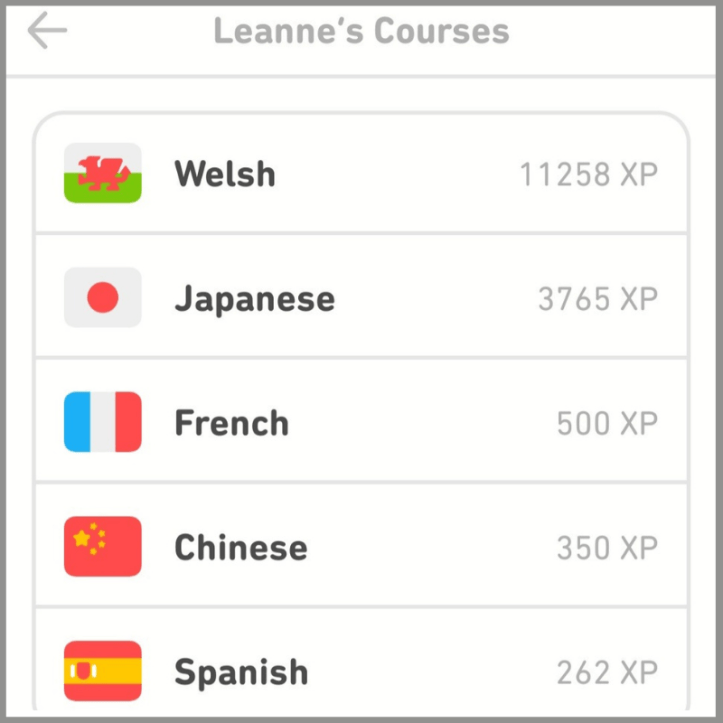
I’ve mentioned before that I have Welsh, Japanese, French, Spanish, and Chinese lessons going. I’ve gone the farthest in Welsh because that was the language that I downloaded the app for originally. Now over 300 days later (it keeps track of your consecutive streaks) Welsh is still first, but I have been working on my Japanese more often than not lately. As they say, you never forget your first love…
What I realized, oh how many years later, is that I will fall into the habit of reaching a point where the language is getting too difficult so I will find a new source to study with, and then another, and another until I am not actually learning anything new – I just have more books, videos saved, or websites bookmarked. Or I decide to learn a new language altogether, as if the same thing won’t happen again. It was a lesson a long time coming, but has made me look at my language learning with fresh eyes and approach it with a better understanding.
I don’t actually recommend going all in with learning five languages at once if you’re also working full-time and have a family. Something gets left on the wayside, and for me that feels like failure. So I made the choice to concentrate on Chinese for the majority of the time, and use the Duolingo app to refresh my Japanese. That’s manageable, and my brain no longer feels like it is going into overload. I know I will return to Welsh again, but not until I have reached my goal with learning Chinese first.
I decided to take a class in Chinese through Coursera, but it’s through videos and short quizzes, not a live class. So, really it’s still self-study. While there are deadlines for the quizzes, they can be adjusted and it’s up to me to find the best ways to study.
So, in the end, self-study language learners of today have a great advantage over the past with all of the information right at their fingertips (as long as they have internet access), but as I’ve discovered, it can also be a disadvantage. It can be overwhelming. You have the ability to learn everything, and it’s tempting to try – especially for someone who runs away when the language learning gets tough. Also, when you watch a video of someone talking about how fluent they are, and had become in a short time, it can make your own struggles seem ridiculous and the urge to give up is all too easy to give in to.
Don’t.
Here’s my advice – and what I have been telling myself recently:
- Pick one or two sources to use and stick with them until you feel comfortable enough to add another that will supplement or go beyond your original sources. (1 or 2 books, or 1 book, 1 Youtube source, etc.)
- Let the successes of others encourage you, rather than get you down. The only one you should be competing with is yourself. Use their tips to help your own learning experience.
- Make a goal that is attainable, and then make it bite-sized. (I want to learn to sing “Wú Gǎn” – so now I break up the song and learn it line by line.)
- Study what interests you. (I love music, so learning to sing along to “Wú Gǎn” isn’t something I will let go of anytime soon.)
You might have noticed that my goal is not “to have a conversation in Chinese.” The thought of talking to a native Chinese speaker in Chinese, specifically Mandarin, terrifies me. I don’t want to ruin their language for them.
But.
What I need to remember is how excited I feel when I’m talking to someone who is still learning English. I am in awe of anyone who can speak more than one language, but to put themselves out there when they are still unsure of their language skills? ROCKSTARS in my opinion. Any language learner makes mistakes, from beginner to even those who are fluent. How often do you use the wrong word for something in your native language? I do it much more often than I’d really like to admit, and I need to remember that when it comes time to have that first conversation in Chinese.
Or Japanese.
Or…
You get the picture.
Are there any other self-study language learners out there?
Thanks for letting me ramble on about a topic close to my heart.
And since I shared the video of Wang Yibo’s song last time, here’s Xiao Zhan’s. It’s from his TV series “Oh! My Emperor.” The show is adorable, his voice is just beautiful, and the video has the English translation!
 lehillwrites.com